ADDITIONAL INFO:
The original Law Of Attraction explained
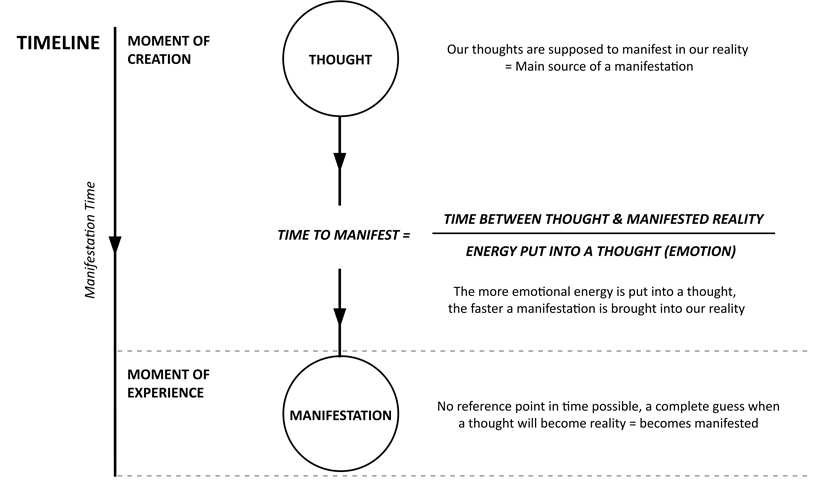
The original theory of the law of attraction states that thoughts create physical realities and that time and space bend to the manifestation of a thought. This theory also claims that physical manifestations occur more quickly when more emotions are attached to a thought. In other words, the emotional power one invests in their thinking plays a crucial role. We are talking about consciously attracting events in our lives through our thoughts, predicting future events, and remotely creating future experiences from other points in time. The ‘law of attraction,’ as popularized in the film and book ‘The Secret,’ indeed seems to contain significant truths. However, at the same time, there appears to be an essential element missing in the original theory. This theory does not provide hard evidence that physical realities are actually attracted by some external force. This ‘law of attraction’ can never be proven without a comparison to an existing theory we can rely on. To prove something, it must be supported by facts that we cannot ignore. The law of attraction is a theory that millions of people around the world are trying to understand and accept as ‘truth.’ However, due to the lack of understanding and the absence of all necessary information, people actually have no idea what this universal law really is or how it works.
There are missing reference points and valuable information that can provide hard evidence; that’s what we truly need before moving on to the next chapter, which involves conducting large-scale scientific experiments, gathering data to evaluate people’s experiences, learning more about human capabilities, and ensuring we are on the right track. A deeper understanding of the creation process will undoubtedly usher in an entirely new era for humanity, an era where knowledge or ‘wisdom’ forms the foundation, and that is exactly where we are heading. The Universal Manifestation Theory offers a solid explanation for life and its wonders; it seems logical while providing us with an entirely new perspective, a new outlook on life, and a whole set of new questions. When we talk about human capabilities, we certainly have much more to learn. Here’s a graphical presentation of the original but misinterpreted law of attraction.
Issues with the original theory
Uncertainty about Timing: One of the main issues with the original theory is the lack of fixed timelines. While it claims that thoughts can manifest realities, it doesn’t provide a concrete method to determine when or even if a thought will actually be realized. This leads to frustration and uncertainty for people attempting to apply this law. They cannot predict when their efforts will bear fruit, often leading to doubt and discouragement.
Based on Personal Belief: The law of attraction is largely based on personal belief. It requires individuals to strongly believe in their thoughts and desires before they can be manifested. However, this belief is difficult to measure and can vary from person to person. Consequently, it can be challenging for some individuals to cultivate the necessary belief to successfully apply the theory.
Lack of Hard Evidence for ‘Attraction’: The original theory of the law of attraction suggests that thoughts create physical realities and that time and space can be influenced by these thoughts. It claims that emotions affect the speed of manifestation. Despite these claims, there is a lack of compelling evidence that there is an actual force that ‘attracts’ physical events based on thoughts. This absence of tangible evidence makes it challenging for scientists to take the theory seriously.
Limited Acceptance in Science: The law of attraction is generally not widely accepted within the scientific community. The concept of thoughts manifesting reality and the measurements of emotional power are problematic and difficult to validate using the rigorous methods of science. Consequently, the theory is not taken seriously by many scientists, resulting in a lack of scientific experiments and research in this area.
Social Stigma and Ridicule: People are often hesitant to openly discuss their beliefs regarding the law of attraction, fearing ridicule or mockery. The lack of scientific validation and the portrayal of the theory as pseudoscience in popular culture contribute to this social stigma. This deters many from sharing their experiences and beliefs.
Some Success Stories but Little Understanding: While some individuals have reported success stories when applying the law of attraction, many struggle to achieve consistent results. This has led to confusion and self-criticism among those who fail to attain their goals. They often see themselves as the cause of their failures, unaware of the complexity and lack of clear guidelines in the original theory.
In summary, the original law of attraction has several challenges and shortcomings that make it difficult to be considered a scientifically sound concept. These issues include uncertainty about timing, the subjective nature of personal belief, the lack of tangible evidence for ‘attraction,’ limited acceptance in science, social stigma and ridicule, and the absence of clear guidelines for success. These challenges have prompted a need for more research and experiments to further clarify and validate the theory.
 TIM IMPENS